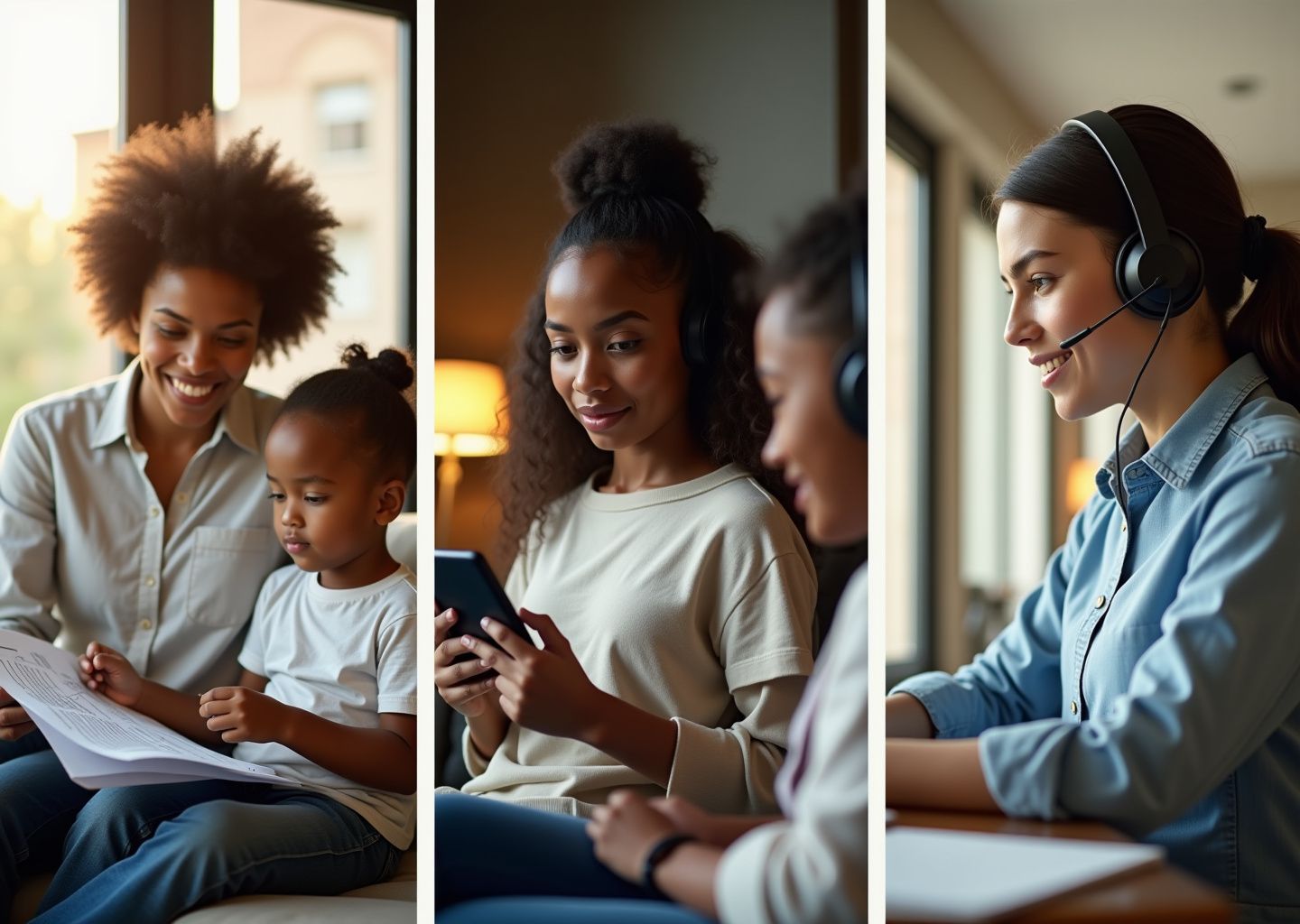
Phone calls can trigger fear and worsen stuttering because of time pressure, lack of visual cues, and unexpected interruptions. This article walks through assessment, daily at-home speech exercises, a graded telephone desensitization plan, practical scripts and worksheets, and age-adapted tips so kids, teens, and adults can practice steadily and regain fluency and confidence when using the phone.
Why the Telephone Feels Hard for People Who Stutter
For many people who stutter, picking up the phone can feel like preparing for a performance without a script. The anxiety is real, and it’s rooted in a combination of psychological pressures and the physical mechanics of speech. Understanding why the telephone is such a specific trigger is the first step toward dismantling its power. It’s not just in your head; the very nature of a phone call changes the communication dynamic and can directly impact speech fluency.
The most immediate change is the loss of visual feedback. In face-to-face conversations, we rely heavily on non-verbal cues. A nod, a smile, or a look of understanding from the listener provides constant, reassuring feedback. It tells us we’re being heard and that the conversation is flowing. On the phone, all of that is gone. You’re speaking into a void, unable to see if the other person is patient, confused, or impatient. This lack of visual information creates uncertainty, and for someone who stutters, that uncertainty can quickly morph into anxiety about how their speech is being received.
This leads directly to a sense of perceived evaluation and time pressure. The silence on the other end of the line can feel deafening. Is the person waiting for me to finish? Are they annoyed? Am I taking too long? This internal monologue creates immense pressure to speak quickly and fluently. The natural pauses in conversation, which feel comfortable in person, can feel like failures on the phone. This pressure to perform is a significant trigger for stuttering. The fear of being judged on your speech alone, without the context of your personality or body language, is a heavy weight to carry into a conversation. Many people, whether they stutter or not, find this aspect of phone calls challenging, as noted by resources like the Stuttering Foundation.
Phone calls also have unpredictable turn-taking. You can’t see when someone is about to speak, leading to awkward interruptions or talking over each other. For a person who stutters, finding the right moment to jump in can be difficult. The fear of being cut off mid-stutter or of not being able to get a word in can increase tension and make it even harder to initiate speech.
This heightened psychological stress has a direct, physical impact on the speech-motor system. When we feel anxious, our body enters a state of high alert. This “fight or flight” response affects the delicate coordination required for fluent speech.
- Respiration
Anxiety often leads to shallow, irregular breathing. Fluent speech relies on a steady, controlled exhale of air from the lungs. When breathing is disrupted, there isn’t enough air support to produce smooth speech, which can lead to blocks or repetitions. - Voice Onset
The vocal folds in our larynx need to vibrate gently to produce sound. Tension caused by anxiety can make the vocal folds clamp together too tightly, making it difficult to initiate voicing. This is what often underlies a silent block, where you know the word but simply can’t get it to come out. - Articulatory Timing
Fluent speech requires precise, split-second coordination of the lips, tongue, and jaw. Anxiety disrupts this fine motor timing. The articulators may move out of sync, get “stuck” in one position, or move with excessive force, resulting in repetitions or prolongations of sounds.
Faced with these challenges, it’s no surprise that many people who stutter develop phone-specific coping behaviors. These often involve avoidance. You might let calls go to voicemail, delay making an important appointment, or rely heavily on texting and email to communicate. Some people spend hours rehearsing what they’re going to say, trying to predict every turn in the conversation to feel a sense of control. While these strategies provide short-term relief, they reinforce the belief that the phone is a threat, strengthening the cycle of fear and avoidance over time.
Evidence-based therapeutic approaches directly address this cycle. Cognitive Behavioral Therapy (CBT) frameworks help identify and challenge the negative thoughts associated with phone use, such as “They will think I’m incompetent if I stutter.” Exposure therapy, a core component of desensitization, involves gradually and systematically facing the feared situation in manageable steps to reduce the anxiety response. This is complemented by established speech therapy techniques. Fluency shaping teaches methods for producing smoother speech, while stuttering modification focuses on reducing the tension and fear associated with the moment of stuttering, allowing for an easier, more forward-moving disfluency.
The difficulty with telephones also varies across the lifespan. For young children, the phone can be an abstract concept, and the pressure they feel may come from a parent’s desire for them to “perform” for a relative. For teenagers, the telephone is a critical tool for social connection, and the fear of stuttering in front of peers can be excruciating, leading to social isolation. For adults, telephone difficulties can create significant barriers in the workplace, limiting career opportunities and making essential daily tasks like scheduling appointments a source of major stress.
Assess, prepare, and set measurable goals for at-home practice
Before you can climb a mountain, you need to know where you’re starting from. The same is true for overcoming telephone anxiety. Jumping into difficult calls without a plan can be overwhelming and counterproductive. Instead, taking the time to assess your starting point, gather the right tools, and set clear, achievable goals will build a solid foundation for success. This preparation phase is not about judgment; it’s about collecting data to guide your journey and celebrate your progress.
First, let’s establish a baseline. This is a snapshot of your current speech and anxiety levels during phone-related tasks. It gives you a concrete starting point to measure against later. You’ll need to record yourself for about two minutes. You can read a passage from a book, talk about your day, or even simulate a simple phone call by yourself. The goal is to get a representative sample of your speech in a low-pressure situation.
Once you have your recording, you can measure two key things:
- Fluency Level: A common metric used by speech-language pathologists is Percent Syllables Stuttered (%SS). To get a rough estimate at home, listen back to your recording and count out the first 100 syllables you spoke. Now, listen again and count how many of those 100 syllables were stuttered (this includes repetitions, prolongations, and blocks). If you stuttered on 12 syllables, your baseline is approximately 12%SS. Don’t worry about getting it perfect; the goal is to have a consistent way to track changes.
- Anxiety Level: Use a simple 0-to-10 scale to rate your anxiety, where 0 is completely calm and relaxed and 10 is the highest level of anxiety you can imagine. Before you make your recording, rate your anticipated anxiety. After you finish, rate the actual anxiety you felt. This subjective rating is just as important as your fluency count because it captures the internal experience you’re working to change. Many people who stutter find that anxiety significantly increases during phone calls, a finding supported by research. You can learn more about this connection in studies like the one published in the Journal of Voice.
With your baseline data, you can now set SMART goals. This framework ensures your objectives are clear and motivating.
- Specific: Clearly define what you want to accomplish. Instead of “be less anxious,” try “lower my anxiety rating from an 8 to a 6 when calling to order a pizza.”
- Measurable: Use the numbers from your baseline. “I will make one 2-minute call where my %SS is below 10%.”
- Achievable: Set realistic goals. Aim for gradual improvement, not perfection. If you currently avoid all calls, a goal of making one call to a friend this week is a great start.
- Relevant: Your goals should matter to you. Do you want to be able to call a doctor’s office, chat with a grandparent, or order takeout with ease? Tie your goals to real-life situations.
- Time-bound: Give yourself a deadline. “I will complete the first three steps of my call hierarchy in the next two weeks.”
To get started, you’ll need a few simple tools. Having everything in one place makes practice easier to approach.
- A phone or headset
- A recording app on your phone or computer to continue tracking your progress
- A timer
- A printed hierarchy worksheet (we’ll build this in the next chapter)
- A daily log to track your practice, call outcomes, fluency counts, and anxiety ratings
- A reinforcement chart to reward yourself for consistent effort, not just “perfect” fluency
This process can be adapted for any age. For young children, a caregiver will lead the process. They can help log calls, rate anxiety using a smiley-face chart, and manage the reinforcement system. For teens and adults, self-monitoring is key. Using a dedicated notebook or a simple spreadsheet to log your own data builds accountability and helps you see patterns over time.
It’s also important to know when to seek professional support. While at-home practice is powerful, it’s not a substitute for professional care. Consider contacting a Speech-Language Pathologist (SLP) who specializes in stuttering if you’re not making progress, if your stuttering is severe, or if you want more structured guidance. If your anxiety feels overwhelming, causes significant distress in other areas of your life, or if you suspect you might have a condition like social anxiety disorder, which is common among adults who stutter, reaching out to a mental health provider is a brave and important step. You can find more information on the link between stuttering and anxiety from organizations like the Stuttering Foundation.
Step-by-step desensitization plan combined with core speech exercises
Now that you’ve assessed your starting point and set clear goals, it’s time to build the ladder you’ll climb to conquer phone anxiety. This process is called desensitization, or graded exposure. The idea is simple but powerful: you start with something that causes very little anxiety and slowly work your way up to more challenging situations. You never move to the next step until you feel comfortable and in control at your current one. We will pair each step on this ladder with specific speech exercises to build fluency skills at the same time you build courage. This dual approach ensures you’re not just enduring calls, but actively reshaping how you speak on them.
Your goal is to keep your anxiety level, which you rated on your 0-10 scale in the last chapter, below a 4 or 5 for each step. If it spikes higher, that’s okay. It’s a sign to stay at the current step a bit longer or even step back for a moment. Use the daily log you prepared to track your progress.
Here is a step-by-step hierarchy. Remember to perform your daily speech practice exercises separately from these exposure sessions. The exercises build the foundation, and the exposure sessions are where you put that foundation to the test.
-
Listen to Recorded Phone Calls
Objective: To become comfortable with the sounds and rhythms of phone conversations without any pressure to speak.
Success Criteria: You can listen to a 5-minute recorded call while keeping your anxiety rating at a 2 or below.
Repetitions: 3-5 sessions.
Paired Speech Practice: While listening, practice deep, calm breathing. Inhale for four counts, hold for four, and exhale for six. This anchors you in a state of calm. Notice the natural pauses and flow of the conversation you’re hearing. -
Record Yourself Reading a Script Aloud
Objective: To practice using your speech tools in the context of a “phone call” without an audience.
Success Criteria: You can record yourself reading a 1-minute script, focusing on technique, with an anxiety rating of 3 or below.
Paired Speech Practice: Use Easy Onset. This means starting words that begin with a vowel (like “I” or “is”) with a gentle, soft, slightly breathy voice. Think of it as easing into the word rather than hitting it hard. Also, practice Light Articulatory Contacts, touching your tongue, teeth, and lips together with minimal pressure when you form sounds. This reduces physical tension in your mouth. -
Role-Play a Call with a Trusted Person in the Same Room
Objective: To simulate a live call in a completely safe environment.
Success Criteria: Complete a 2-minute scripted role-play call, maintaining an anxiety level of 4 or below.
Repetitions: 3-5 times with a supportive partner.
Paired Speech Practice: Focus on Phrasing and Pausing. Read your script in shorter, natural phrases, taking a brief, relaxed pause between them. This breaks up long sentences, gives you time to breathe, and prevents the feeling of being rushed. -
Call an Automated Line (e.g., Weather, Movie Times)
Objective: To use a real phone for a one-way conversation.
Success Criteria: You successfully make the call and say a short phrase or number (e.g., your zip code) with an anxiety rating of 4 or below.
Repetitions: 5-10 calls.
Paired Speech Practice: Before you dial, take one slow, deep breath. As you bring the phone to your ear, use an Easy Onset on your very first word. For example, if your zip code starts with “eight,” instead of a hard start, you would ease into it with a gentle, breathy “hhh-eight…” This is a micro-technique you can use to start any call on the right foot. -
Call a Familiar Person with a Full Script
Objective: To have a successful, predictable conversation with a live, supportive person.
Success Criteria: Complete a short, scripted call (e.g., “Hi, it’s me. Just calling to see what time you’ll be home. Okay, thanks, bye!”) with anxiety staying at or below 5.
Repetitions: 3-5 calls to different familiar people.
Paired Speech Practice: Combine Easy Onset for the start of the call with Light Contacts throughout. If you feel tension rising, take a strategic pause. It’s perfectly normal to pause in a conversation. -
Call a Familiar Person with Bullet Points Instead of a Script
Objective: To begin fading the script and rely more on spontaneous speech in a low-pressure setting.
Success Criteria: Have a 2-3 minute conversation using only 2-3 bullet points as your guide. Keep anxiety below 5.
Paired Speech Practice: This is where Sliding comes in. If you feel a block coming on a word, “slide” into it by prolonging the first sound (e.g., “Sssssssaturday”). This keeps your voice moving forward and releases the physical tension of the block. -
Make a Short, Predictable Call to an Unfamiliar Person
Objective: To ask for a single piece of information from a stranger.
Success Criteria: You successfully call a business to ask for their hours or location, keeping anxiety at a 6 or below.
Repetitions: 5-7 calls to different businesses.
Paired Speech Practice: This is a high-stakes moment for your micro-technique. Before you speak, use the 3-second inhale. Then, use a very gentle Easy Onset on your first phrase, like “Hhhhhi, can you tell me what time you close?” -
Make a Longer Call Requiring Some Interaction
Objective: To handle a multi-step conversation, like ordering food or making a simple appointment.
Success Criteria: Complete the call successfully, even if you have to ask for a moment or repeat information. Keep anxiety below 7.
Repetitions: 3-5 calls.
Paired Speech Practice: Use Continuous Phonation. Try to link words within a phrase together with a smooth, continuous voice, almost like you’re singing them. This reduces the number of hard starts that can trigger a stutter. For example, “I’d-like-to-order-a…” becomes one smooth vocal stream. -
Make a Scheduled Professional Call
Objective: To handle a higher-stakes call where you have time to prepare.
Success Criteria: You participate in the call, state your main points, and manage any moments of disfluency without ending the call early. Anxiety may be high (7-8), but success is defined by participation, not perfect fluency.
Repetitions: As they arise naturally.
Paired Speech Practice: Rely on all your tools. Use bullet points to plan. Start with your breathing and Easy Onset. Use strategic pausing to gather your thoughts. If you get stuck, use the Sliding technique to move through the word. -
Handle an Interruption or Unexpected Question
Objective: To practice staying calm and regaining control when a call goes off-script.
Success Criteria: When interrupted, you take a deliberate pause and a breath before responding, rather than rushing and increasing tension.
Paired Speech Practice: The pause is your most powerful tool here. When someone asks an unexpected question, don’t feel pressured to answer instantly. Say, “Hmm, let me see,” or simply take a silent 3-second pause. This gives you time to reset, breathe, and plan your response using your speech strategies.
As you progress, the goal is to fade your reliance on full scripts. Move from a word-for-word script to a list of key bullet points. From there, try reducing it to just the single most important phrase you need to say. Eventually, you’ll be able to go into most calls with just a mental plan. If tension increases at any step, don’t be afraid to go back to an earlier, more comfortable step for a few days. This isn’t a race; it’s about building a solid, lasting foundation of confidence.
Daily practice plans, scripts, worksheets, and technology aids
Consistency is the engine that drives progress. The desensitization hierarchy and speech exercises from the previous chapter work best when they become part of a regular routine. A structured plan removes the guesswork and helps you build momentum, turning small, daily efforts into lasting confidence. Below are concrete plans, scripts, and tools to help you put theory into practice.
Daily Practice Plans
Your plan should adapt as you become more comfortable. Start where you feel challenged but not overwhelmed.
-
Beginner Plan (10–15 minutes, twice daily)
The focus here is on building foundational speech skills and tackling low-anxiety phone situations.- Morning (10-15 min): 5 minutes of speech exercises (like easy onset or light articulatory contacts). 5-10 minutes of a low-hierarchy task, such as listening to a recorded phone call or reading a script aloud to yourself on speakerphone.
- Evening (10-15 min): 5 minutes of reviewing your speech targets. 5-10 minutes of role-playing a simple call with a family member or calling a pre-recorded message line (like a movie showtime hotline) just to listen.
-
Intermediate Plan (20–30 minutes, daily)
Here, you’ll increase the difficulty of live calls and begin to rely less on scripts.- Daily Session (20-30 min): 5 minutes of speech exercise warm-ups. 15-20 minutes dedicated to making one or two live calls from your hierarchy, such as calling a store to ask for their hours or ordering a pizza. Use a script with key phrases, not a word-for-word document. Spend the last 5 minutes filling out your log and reflecting on the call. What went well? What will you focus on next time?
-
Advanced Plan (30+ minutes, daily or as needed)
The goal is to handle spontaneous, complex calls and maintain your skills.- Practice Session (30+ min): 5 minutes of a quick speech warm-up. The core of your practice is making more challenging or unexpected calls. This could be calling customer service to resolve an issue, participating in a work-related conference call, or returning a call to an unfamiliar number. Focus on using your speech strategies in spontaneous conversation. After the call, take a moment to assess your performance and anxiety levels.
Tracking Your Progress
Logging your practice is crucial. It provides tangible evidence of your hard work and helps you see patterns in your anxiety and fluency.
Exposure and Fluency Log
Use a simple notebook or a digital document to create a log like this. It helps you objectively see how your anxiety decreases and control increases over time.
| Date | Call Task | Anxiety (1-10) Pre-Call | Anxiety (1-10) Post-Call | Fluency (1-10) | Notes & Successes |
|---|---|---|---|---|---|
| 12/25/25 | Called library for hours | 7 | 4 | 6 | Used easy onset on “Hello.” Paused before asking my question. Felt a block on “hours” but slid through it. |
| 12/26/25 | Ordered takeout | 8 | 5 | 7 | The person on the other end was patient. I used my pausing strategy and it helped a lot. Didn’t need the script as much. |
Reinforcement Chart for Kids
For younger children, a visual reward system can be very motivating. Create a simple chart with a goal, like “Practice Phone Calls,” and days of the week. Let your child add a sticker or a checkmark after completing a practice session. When they fill a row, celebrate with a small, pre-determined reward, like extra screen time or choosing a family movie. The focus should be on celebrating the effort, not on achieving “perfect” fluency.
Sample Phone Scripts and Speech Targets
Scripts are your training wheels. They reduce the mental load of figuring out *what* to say so you can focus on *how* you say it.
Script 1: Calling a Family Member (Beginner)
This is a low-stakes call to practice basic interaction.
You: Hi, [Name]. It's [Your Name].
Them: Hi! How are you?
You: I'm good, thanks. I'm just calling to say hello and see how you are.
(Listen and respond)
You: Well, I have to go now. It was great talking to you. Bye!

Speech Targets: Use a gentle onset on your first "Hi." Pause briefly after they answer before you start talking.
Script 2: Making an Appointment (Intermediate)
This involves a clear exchange of information.
You: Hello. I'd like to schedule an appointment with Dr. Smith.
Receptionist: Of course. What day works for you?
You: Do you have anything available next Tuesday afternoon?
(Listen and respond to options)
You: Okay, 2:00 PM on Tuesday works for me. My name is [Your Full Name].
(Confirm any other details)
You: Great, thank you for your help. Goodbye.

Speech Targets: Use light articulatory contacts on "Tuesday" and "two." Use pausing to break the sentences into shorter phrases.
Script 3: Leaving a Voicemail (Intermediate/Advanced)
This requires you to be concise and clear without real-time feedback.
Hi, this is a message for [Name]. My name is [Your Name], and my phone number is [Your Number]. I'm calling about [briefly state reason]. Please call me back when you have a moment. Thank you.

Speech Targets: Take a calm breath before you start. Speak at a slightly slower pace than usual. Focus on continuous phonation, linking words within a phrase together smoothly.
Practice Methods and Technology
Role-Play and Recording
Before making a live call, role-play it with a parent, friend, or coach. Have them act as the receptionist or customer service agent. This builds muscle memory in a safe environment. You can also record these practice sessions or even your live calls (with permission) using a smartphone app. Listening back helps you identify successes and areas for improvement. Did you use your easy onsets? Did you remember to pause? Self-feedback is a powerful tool for change.
Supportive Technology and Aids
Modern technology offers many tools to support your practice.
- Recording Apps: Standard voice memo apps on any smartphone are perfect for recording practice sessions or leaving practice voicemails for yourself.
- Call Scheduling: Use your calendar to block out time for practice calls. Treating it like any other appointment increases the likelihood you’ll follow through.
- Remote SLP Sessions: Teletherapy allows you to work with a certified Speech-Language Pathologist from the comfort of your home, providing expert guidance and coaching for phone-based challenges.
Privacy and Practical Tips
When recording calls, always consider privacy. In many places, two-party consent is required, meaning you must inform the other person they are being recorded. For practice, it’s best to only record calls with friends or family who have given you explicit permission. To make calls feel less intense, use a headset or speakerphone. This frees your hands and can reduce the cognitive load, allowing you to focus more on your speech techniques rather than juggling a handset. It also externalizes the voice, which some people find less intimidating than having it directly in their ear.
Frequently Asked Questions
As you put the plans and worksheets from the previous section into action, questions will naturally come up. This is a normal part of the process. Below are answers to some of the most common concerns that arise during at-home practice for phone anxiety and stuttering.
How long will it take to see progress?
There is no universal timeline. Progress is highly individual and depends on factors like the severity of your anxiety, the consistency of your practice, and your personal goals. Some people feel a small boost in confidence after just a week of making low-stakes calls. For others, it might take a month or more to feel a noticeable shift. It’s important to redefine what “progress” looks like. Instead of aiming for perfectly fluent speech, celebrate small victories. Did you pick up the phone when you wanted to hang up? Did you use a fluency technique during a difficult moment? Did your anxiety rating drop from a 9 to an 8? These are all meaningful signs of progress. Consistency is more important than intensity. A steady 15 minutes of practice each day will build skills more effectively than one long, stressful session per week.
What should I do if my child refuses to practice?
Resistance from a child is often a sign of fear or frustration, not defiance. Forcing practice will likely increase their anxiety and create a negative association with the phone. Instead, try to approach it as a team. Acknowledge their feelings by saying something like, “I know this feels really hard right now.” Revisit the practice hierarchy together. Was the chosen step too difficult? Go back to an easier one. Involve them in the process by letting them choose the person to call or the topic to discuss. Use the reinforcement chart mentioned in the previous chapter to celebrate effort, not just perfect outcomes. Keep practice sessions short, positive, and end on a successful note, even if it’s just role-playing a two-line script.
How can I handle a panic attack or a severe block during a call?
Feeling a wave of panic or getting stuck in a severe block can be overwhelming. The key is to have a plan. First, use a grounding technique. Press your feet firmly into the floor and notice the sensation. Take a slow, quiet breath. It’s perfectly acceptable to pause. You can say, “Just a moment, please,” to give yourself space. If you have a script, glance at it to find your place. Focus on the listener and the purpose of your call rather than on your own speech. If the moment feels too intense, it is okay to end the call politely and try again later. You can say, “Something has come up, can I call you back?” Every call is a learning opportunity, not a pass-or-fail test.
Should I just avoid phone calls until I feel more confident?
Avoiding phone calls is a very common coping mechanism, but it ultimately strengthens the fear. Each time you avoid a call, your brain learns that the phone is a genuine threat and that avoidance is the way to feel safe. This creates a powerful cycle of fear and avoidance. The entire principle of desensitization is based on gently and gradually confronting the fear, not running from it. Following the step-by-step hierarchy ensures you are challenging yourself in a manageable way. Even making one very short, highly predictable call is a better strategy than complete avoidance.
Are there any medications that can help with stuttering or phone anxiety?
Currently, there are no medications approved by the FDA specifically to treat stuttering. Some medications used for anxiety, like SSRIs, may be prescribed “off-label” to help manage the severe anxiety that can accompany stuttering. However, these medications do not treat the core speech disfluencies. They may help reduce the overall emotional distress, which can indirectly improve fluency for some individuals. This is a complex decision that should only be made in consultation with a medical doctor or psychiatrist who can discuss the potential benefits and side effects. Medication is never a substitute for speech therapy and behavioral practice.
Can teletherapy be as effective as in-person therapy?
For many teens and adults working on phone-related anxiety and stuttering, teletherapy can be just as effective, and sometimes even more so. It allows you to practice in the exact environment where you experience the difficulty—your home or office. It eliminates travel time and can feel less intimidating than a clinical setting. However, the success of teletherapy depends on the individual. Some younger children may benefit more from the hands-on, dynamic interaction of in-person sessions. A stable internet connection is also essential. Ultimately, the best format is the one that you or your child can consistently attend and feel comfortable with.
When is it time to see a certified speech-language pathologist (SLP) or a mental health professional?
While at-home practice is powerful, professional guidance is crucial in many cases. You should seek an SLP if stuttering is significantly impacting school, work, or social life; if at-home efforts lead to increased frustration with no progress; or if you need help with specific speech techniques beyond what’s covered here. If the anxiety around speaking is severe, leading to broad social avoidance, depression, or panic attacks, it is wise to consult a mental health professional, such as a psychologist or counselor. Research shows a high co-occurrence of social anxiety and stuttering, with some studies indicating that up to 60% of adults seeking stuttering treatment also meet the criteria for social anxiety disorder. Often, the most effective approach involves both an SLP and a mental health professional working together.
What if I hit a plateau or have a bad speech day?
Plateaus and setbacks are an expected part of building any new skill. Fluency is naturally variable and can be affected by stress, fatigue, or pressure. When you have a difficult call or a “bad speech day,” try not to view it as a failure. See it as data. What were the circumstances? Was the call more complex than you were ready for? Were you tired? Use this information to adjust your practice plan. Perhaps you need to return to an easier step on your hierarchy for a few days to rebuild confidence. Reframe your goal from “perfect fluency” to “resilient communication.” The real skill is not never stuttering; it’s learning to move forward, communicate effectively, and manage your anxiety even when you do.
Conclusion and next steps
You’ve journeyed through the mechanics of why phone calls can feel so daunting and how to systematically dismantle that fear. We’ve seen that the telephone strips away the non-verbal cues we rely on, creating a unique pressure cooker of time constraints and performance anxiety. This environment can amplify disfluency and the fear associated with it. The core of our approach has been a two-part strategy: graded desensitization, which allows you to reclaim control by facing your fears in small, manageable increments, and targeted speech exercises, which give you the practical tools to manage your speech mechanics. The key to making this work isn’t about achieving “perfect” fluency overnight. It’s about consistent, measurable practice. Tracking your progress, even the small wins, builds momentum and rewires your brain’s response to the phone. For kids and teens, this process is most effective when supported by parents and caregivers who can help structure the practice, celebrate effort over outcomes, and create a safe environment for taking these brave steps.
This entire journey is built on taking one step at a time. To get you started right now, here is a simple, three-point action plan you can implement today.
-
Establish Your Baseline.
Before you begin, complete the assessment described in the “Assess, prepare, and set measurable goals” section. Record a short speech sample to calculate your initial Percent Syllables Stuttered (%SS) and use the 0-10 scale to rate your current phone anxiety. This data is your starting point and will be crucial for tracking your progress. -
Choose Your First Two Steps.
Review the step-by-step desensitization plan and select your first, most manageable task. Then, identify the next one. Write them down. Your immediate goal is to master step one until it feels comfortable before moving to step two. This focused approach prevents overwhelm and builds momentum. -
Commit to Five Minutes a Day.
Lasting change comes from consistency, not intensity. Dedicate just five minutes daily to practice a speech exercise or attempt your first hierarchy step. This small, sustainable habit is key to building new skills and rewiring your response to phone calls over time.
While this at-home program can create profound change, it’s important to recognize when more support is needed. If stuttering is severe, persistent, or causing significant emotional distress, we strongly encourage consulting with a certified Speech-Language Pathologist (SLP). An SLP can provide a formal diagnosis, create a highly individualized treatment plan, and offer specialized techniques that go beyond the scope of this guide.
Furthermore, for many people, telephone anxiety is deeply intertwined with broader patterns of social anxiety. Up to 60% of adults who seek treatment for stuttering also meet the criteria for social anxiety disorder. If you find that negative thought patterns, catastrophic thinking, or intense panic are major barriers, combining these behavioral practices with cognitive strategies can be incredibly effective. Techniques from Cognitive Behavioral Therapy (CBT), for example, can help you identify, challenge, and reframe the unhelpful thoughts that fuel the anxiety cycle. An SLP or a mental health professional can be an invaluable partner in integrating these approaches, helping you build not just a more fluent voice, but a more confident and peaceful mind.
References
- Comparison of Stuttering Severity and Anxiety During Standard and Challenge Phone Calls — Study showing that both stuttering severity and anxiety can increase during challenging phone calls.
- Why does the phone strike fear into the hearts of so many of us? — Article discussing telephone anxiety in the workplace, noting that speech difficulties affect roughly three million Americans.
- How Many People Stutter in the USA? – Dr. Fluency — Cites the statistic that about 1% of Americans stutter, with a higher lifetime incidence.
- Speech and Anxiety Management With Persistent Stuttering: Current Evidence — Discusses the high prevalence of social anxiety disorder among those who stutter.
- The Association Between Stuttering Burden and Psychosocial Well-Being — Notes that the prevalence of stuttering is as high as 8% in young children.
- Using The Telephone | Stuttering Foundation — Resource page acknowledging that many people, with or without a stutter, have difficulty using the telephone.
- Stuttering 101 – Friends — States that stuttering affects approximately 1% of the global population and 3 million Americans.
- Behind the mask: Stuttering, anxiety, and communication dynamics — Highlights that up to 60% of adults in stuttering treatment also meet the criteria for social anxiety disorder.
Legal Disclaimers & Brand Notices
The content of this article is provided for informational purposes only and is not intended to be a substitute for professional medical or therapeutic advice, diagnosis, or treatment. Always seek the advice of a qualified healthcare provider, such as a certified Speech-Language Pathologist (SLP), physician, or mental health professional, with any questions you may have regarding a medical condition, therapeutic intervention, or the use of medication.
Reliance on any information provided in this article is solely at your own risk. Never disregard professional medical advice or delay in seeking it because of something you have read here.
All product names, logos, and brands mentioned in this publication are property of their respective owners. Use of these names, logos, and brands does not imply endorsement.